

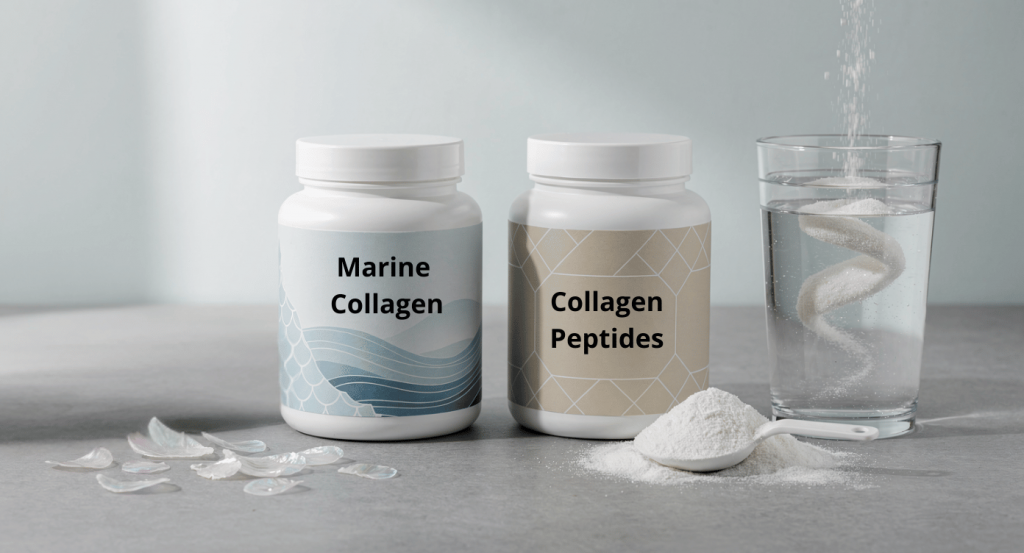
Short answer: neither is universally “better.” The best option depends on source preference, absorption expectations, and sustainability goals. Marine collagen comes from fish and is naturally rich in type I collagen, while collagen peptides refer to hydrolyzed collagen that can come from marine or bovine sources and is designed for easier digestion.
To make the right choice, it’s essential to understand how they differ in structure, origin, bioavailability, and use cases.
Key takeaways:
- Marine collagen is defined by its source (fish skin and scales).
- Collagen peptides are defined by their form (hydrolyzed for absorption).
- Both can be effective when quality, dosage, and consistency are respected.
What is marine collagen?
Marine collagen is collagen extracted from fish skin, scales, or bones. It is naturally rich in type I collagen, the main collagen type found in human skin and connective tissues.
It is commonly chosen for:
- Skin elasticity and firmness
- Hair and nail strength
- A more sustainable sourcing approach
Marine collagen often has a lower molecular weight, which may support easier absorption when consumed regularly.
What are collagen peptides?
Collagen peptides are collagen molecules that have been hydrolyzed, meaning they are broken into smaller amino-acid chains. This improves digestibility and solubility.
Key points:
- Easily absorbed
- Neutral taste
- Can be sourced from marine or bovine collagen
Important clarification: marine collagen can also be collagen peptides if it has been hydrolyzed.
The core difference explained simply
| Marine collagen | Collagen peptides |
| Focuses on the source | Focuses on the form |
| Always fish-based | Fish or bovine |
| May be native or hydrolyzed | Always hydrolyzed |
| Popular for beauty benefits | Popular for ease of use |
Which one is better for your goal?
Once the difference between marine collagen and collagen peptides is clear, the real question becomes: which one fits your needs best? The answer depends on what you expect from supplementation.
For skin, hair, and nails
Marine collagen is naturally rich in type I collagen, the form most abundant in human skin. When taken consistently, it is often associated with:
- Improved skin elasticity
- Reduced appearance of fine lines
- Stronger hair and nails
Collagen peptides, when hydrolyzed, enhance absorption. This means marine collagen peptides combine the benefits of both source and form, making them a popular option for beauty-focused routines.
For joints and connective tissues
Joint support depends on providing the body with amino acids that help maintain cartilage and tendons. In this case:
- Collagen peptides offer faster digestion
- Consistent daily intake matters more than origin
- Both marine and non-marine peptides can be effective
For joint comfort, form (hydrolyzed) is generally more important than source.
For digestion and tolerance
Digestive comfort is a common deciding factor.
- Collagen peptides dissolve easily and are usually well tolerated
- Marine collagen is often lighter than bovine collagen
- Native (non-hydrolyzed) collagen may be harder to digest
If digestion is a priority, hydrolyzed collagen peptides are typically the safest choice.
Lifestyle and dietary preferences
Your personal values may also influence the decision:
- Marine collagen suits pescatarian diets
- Collagen peptides offer more format flexibility
- Sustainability-conscious users often prefer marine sources
Key insight: For most people, the best balance comes from marine collagen peptides, combining easy digestion with skin-focused benefits.
Dosage, timing, and common mistakes
Even the best collagen won’t deliver results if it’s taken incorrectly. Dosage, consistency, and timing matter more than most people think.

How much collagen should you take?
Most research-backed benefits appear within a daily range of 2.5 g to 10 g.
- 2.5–5 g per day: suitable for skin hydration and early anti-aging support
- 5–10 g per day: commonly used for visible skin, hair, and joint benefits
- Higher doses rarely provide extra benefits if consistency is lacking
Taking less than 2 g per day is usually insufficient to trigger measurable effects.
When is the best time to take collagen?
There is no single perfect time, but certain habits can improve consistency:
- Morning, mixed with water or coffee
- Post-workout, for tissue recovery
- Evening, as part of a calming routine
What matters most is daily repetition, not the clock.
How long before results appear?
Collagen works gradually.
- First sensations: 3–4 weeks
- Visible skin or joint changes: 6–8 weeks
- Full benefits: 8–12 weeks of uninterrupted use
Stopping too early is one of the most common reasons people think collagen “doesn’t work.”
Common mistakes to avoid
- Choosing non-hydrolyzed collagen
- Taking collagen irregularly
- Expecting immediate results
- Ignoring the role of vitamin C, which supports collagen synthesis
- Focusing on source alone instead of form + dosage
Important note: Consistency over 8–12 weeks matters more than increasing the dose beyond 10 g per day.
Summary: which one should you choose?
There is no strict winner between marine collagen and collagen peptides. The key difference lies in source versus form.
Marine collagen refers to collagen derived from fish and is often chosen for skin-focused benefits and lifestyle preferences. Collagen peptides refer to collagen that has been hydrolyzed for better absorption, making them easier to digest and more efficient for consistent daily use.
For most people, the most practical option is marine collagen peptides, as they combine:
- A marine source rich in type I collagen
- A hydrolyzed form that supports absorption
- Versatility and long-term tolerance
Ultimately, results depend less on the label and more on quality, correct dosage, and consistency over time.