

Short answer: most adults benefit from 2.5 to 10 grams of collagen per day, depending on their goal (skin, joints, muscle recovery). For many people, 5–10 g daily is the effective range used in clinical studies.
Collagen has become one of the most popular supplements for skin health, joint comfort, and overall structural support. Yet dosage remains confusing. Some sources mention small daily amounts, while others recommend much higher intakes. So how much collagen per day is actually useful, and when does more stop being beneficial?
This guide breaks down the effective daily collagen dosage, explains why recommendations vary, and helps you choose the right amount based on gender, age, and goals, with a clear, evidence-based approach.
Key takeaways:
- Most benefits appear between 5 and 10 g of collagen per day.
- Lower doses (2.5 g) can still support skin health.
- Higher intakes don’t always mean better results.

Why collagen dosage matters
Collagen is a structural protein, not a vitamin. That means it follows different rules when it comes to absorption and effectiveness. Below a certain threshold, results may be minimal. Above another threshold, excess amino acids are simply used as general protein or excreted.
When asking how much collagen per day, the real question is: how much is needed to trigger measurable benefits without waste?
Research consistently shows that collagen peptides are effective within a moderate daily window, especially when taken regularly over several weeks. This is why most protocols focus on daily consistency rather than very high doses.
Typical daily collagen ranges explained
Here’s how daily collagen intake is generally categorized:
- 2.5 g per day
Often used for skin elasticity and hydration, especially in younger adults or preventive routines. - 5 g per day
A common baseline for general wellness, hair, nails, and early joint support. - 10 g per day
Frequently used for joint comfort, muscle recovery, and visible skin changes.
This explains why questions like how much marine collagen per day or how much collagen per day for a woman don’t have a single universal answer. Needs change with age, lifestyle, and physiological stress.
A key nuance: collagen works best when taken daily for at least 8–12 weeks. Sporadic use even at high doses rarely delivers results.
How much collagen per day for a woman?
When it comes to how much collagen per day for a woman, the effective dosage depends mainly on age, hormonal status, and lifestyle. Women tend to experience a faster decline in collagen production, especially after 30 and even more noticeably around menopause.
For most women, the ideal daily intake falls within this range:
- 2.5–5 g per day
Suitable for younger women (20s–early 30s) focused on skin hydration, hair, and nails. - 5–10 g per day
Recommended for women over 30, during hormonal changes, high stress, or visible skin aging.
This is why many experts converge on 10 g per day as a practical upper target: it consistently supports skin firmness, joint comfort, and connective tissue strength without unnecessary excess.
Does marine collagen change the dosage?
A common question is how much marine collagen per day compared to other sources. In practice, the dosage is the same, but marine collagen is often preferred because it is rich in type I collagen, the dominant form found in skin.
What truly matters is not increasing the dose, but ensuring:
- High-quality hydrolyzed collagen peptides
- Daily intake over several weeks
- Adequate vitamin C intake (diet or formula)
One important point: beyond 10–15 g per day, additional collagen does not appear to provide proportionally greater benefits for most women.
Is taking 10 g of collagen per day too much?
For most healthy adults, taking 10 g of collagen per day is not too much. In fact, it sits at the upper end of the effective range commonly used in studies focused on skin aging, joint support, and muscle recovery.
At this dosage, collagen is generally:
- Well tolerated
- Easily absorbed when hydrolyzed
- Used efficiently by the body for connective tissues
This is why 10 g is often considered a “functional dose” rather than an excessive one.
Can you take more than 10 g per day?
While some protocols go higher, increasing the dose beyond 10–15 g per day does not automatically improve results. At that point, collagen behaves more like a generic protein source, and the extra amino acids may not specifically support collagen synthesis.
A useful rule of thumb:
- Below 5 g: light, preventive support
- 5–10 g: optimal daily range
- Above 15 g: limited added value for most people
One practical tip: if digestion feels heavy, splitting the dose into two smaller intakes can improve comfort without changing effectiveness.
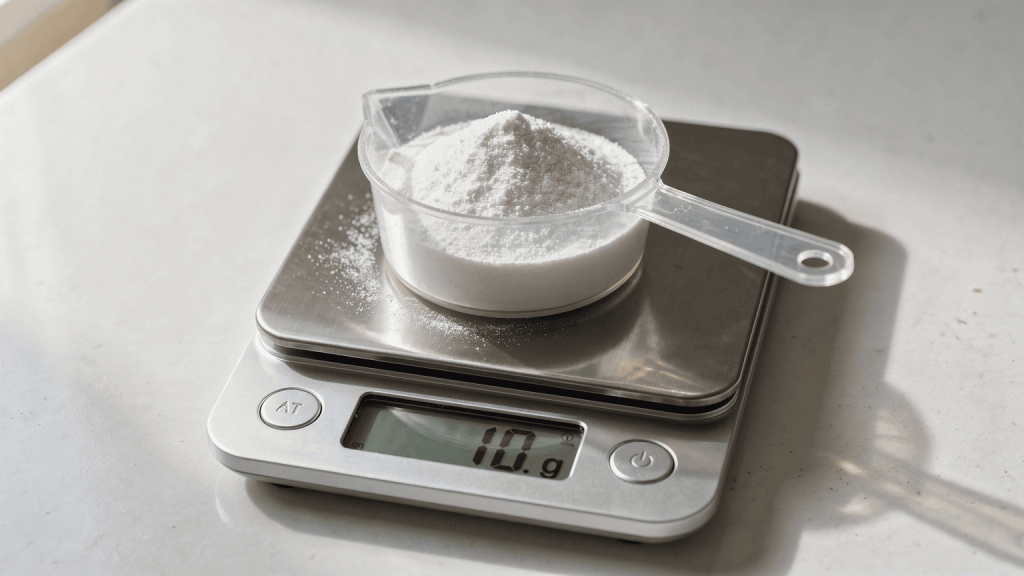
How much collagen per day : practical summary
To answer the question how much collagen should I take per day, the most reliable approach is to match the dose to your goal and stay consistent over time.
Recommended daily collagen intake
| Goal | Daily amount |
| Skin hydration & prevention | 2.5–5 g per day |
| Visible skin aging & joints | 5–10 g per day |
| Active lifestyle or recovery | 10 g per day |
Most people don’t need more than 10 g daily to see benefits. What matters most is daily use over several weeks, not pushing the dose higher.
Key point: Consistency within the effective range (5–10 g/day) delivers better results than occasional high doses.
Final guidance
If you’re still unsure how much collagen per day is right for you, start at 5 g daily for two weeks, then increase to 10 g if your goal includes joint comfort or visible skin support. This progressive approach maximizes tolerance and effectiveness.
Used this way, collagen becomes a long-term nutritional support, not a short-term fix making the daily dose simple, safe, and effective.