

In most situations, bright yellow or green urine after taking multivitamins is completely harmless. It is usually caused by an excess of water-soluble B vitamins, especially riboflavin (vitamin B2), that your body does not need and simply excretes.
The simplest fix is to adjust how and when you take your multivitamin often by taking it with food and ensuring adequate hydration. In many cases, the color returns to normal within 24 to 48 hours without any further action.
• Bright urine after multivitamins is usually due to excess B vitamins
• The phenomenon is benign and temporary
• Proper intake timing often resolves it quickly
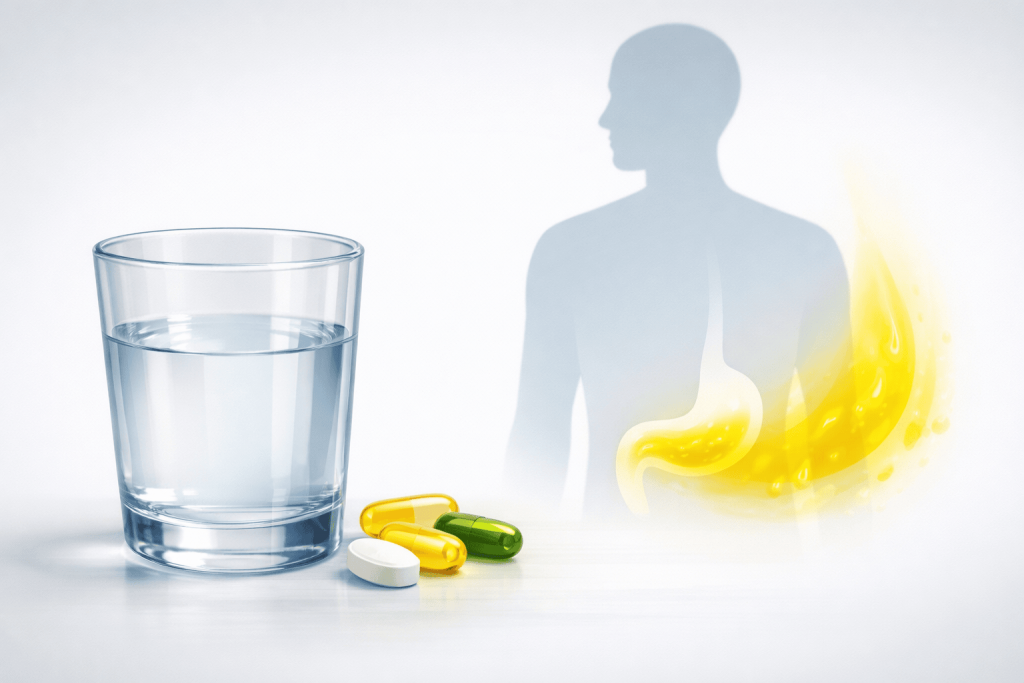
Why this happens after using multivitamins
From a nutritional standpoint, this reaction is easy to explain.
Most multivitamins contain high doses of B-complex vitamins, particularly B2 (riboflavin) and sometimes B12. These vitamins are water-soluble, meaning your body absorbs what it needs and eliminates the rest through urine.
Riboflavin has a naturally fluorescent yellow-green color, which becomes very visible when excreted in concentrated urine. This explains why many people notice the color change shortly after ingestion.
Several factors can amplify the effect:
- High-dose formulations with B vitamins well above daily needs
- Taking multivitamins on an empty stomach, leading to rapid absorption
- Low fluid intake, which concentrates urine
- Individual sensitivity to B-vitamin metabolism
Importantly, this color change does not indicate toxicity, kidney damage, or inefficiency of the supplement.
What to do concretely to correct the issue
You do not need to stop supplementation immediately. Instead, apply these practical steps.
First, always take your multivitamin with a main meal, preferably breakfast or lunch. Food slows absorption and improves utilization.
Second, ensure you are properly hydrated throughout the day. Pale yellow urine is usually a sign of adequate hydration.
Third, observe the timing. If the color appears within a few hours and fades later in the day, this confirms a benign vitamin excretion effect.
If the color remains very intense despite good hydration and proper intake timing, it may be a sign that the formulation is unnecessarily concentrated for your needs.
The formulation choice makes all the difference
Not all multivitamins are designed the same way. Some products rely on very high B-vitamin dosages as a marketing argument, even when such amounts provide no additional benefit for most users.
These formulations increase urinary excretion and visual side effects without improving nutritional status.
A balanced multivitamin with controlled B-vitamin levels is often the most coherent option. It supplies essential micronutrients without overwhelming elimination pathways, which reduces unnecessary urine color changes.
As a nutritionist, I consider this type of formulation the simplest and most reliable solution for people who want daily supplementation without confusing or worrying side effects.
Example of simple and effective use
The goal is consistency and tolerance rather than maximal dosage.
| Timing | How to take | Expected effect | Tolerance |
|---|---|---|---|
| Breakfast or lunch | Multivitamin with food | Better absorption, less urine discoloration | High |
| Throughout the day | Regular water intake | Diluted urine color | Excellent |
This approach keeps supplementation effective while minimizing visual side effects.
Bright urine alone is not a warning sign, but persistent discoloration with other symptoms should not be ignored.
Common mistakes that maintain the problem
- Taking multivitamins on an empty stomach → always combine with food
- Using high-dose formulas “just in case” → favor balanced compositions
- Poor hydration → drink consistently during the day
- Doubling doses → unnecessary and counterproductive
Correcting these habits usually resolves the issue completely.

My nutritionist’s opinion
Bright yellow or green urine after multivitamin use is one of the most misunderstood post-purchase effects. In the vast majority of cases, it reflects normal vitamin metabolism rather than a problem.
The real solution is not to stop supplementing, but to choose a well-formulated multivitamin and use it correctly. Balanced doses, taken with food and adequate hydration, make supplementation both effective and reassuring.
From a practical standpoint, this remains the simplest and most reliable way to avoid unnecessary concern while maintaining micronutrient intake.